New Nonfiction · Available for preorder

Bitcoin's Quantum Countdown

How Quantum Computing Could Challenge Bitcoin—and the Race to Secure the Future of Digital Money
by Yonas GebremichaelPublishes October 20, 2026

A serious, evidence-led look at Bitcoin's cryptography and quantum computing research — without hype, without a predicted collapse date.

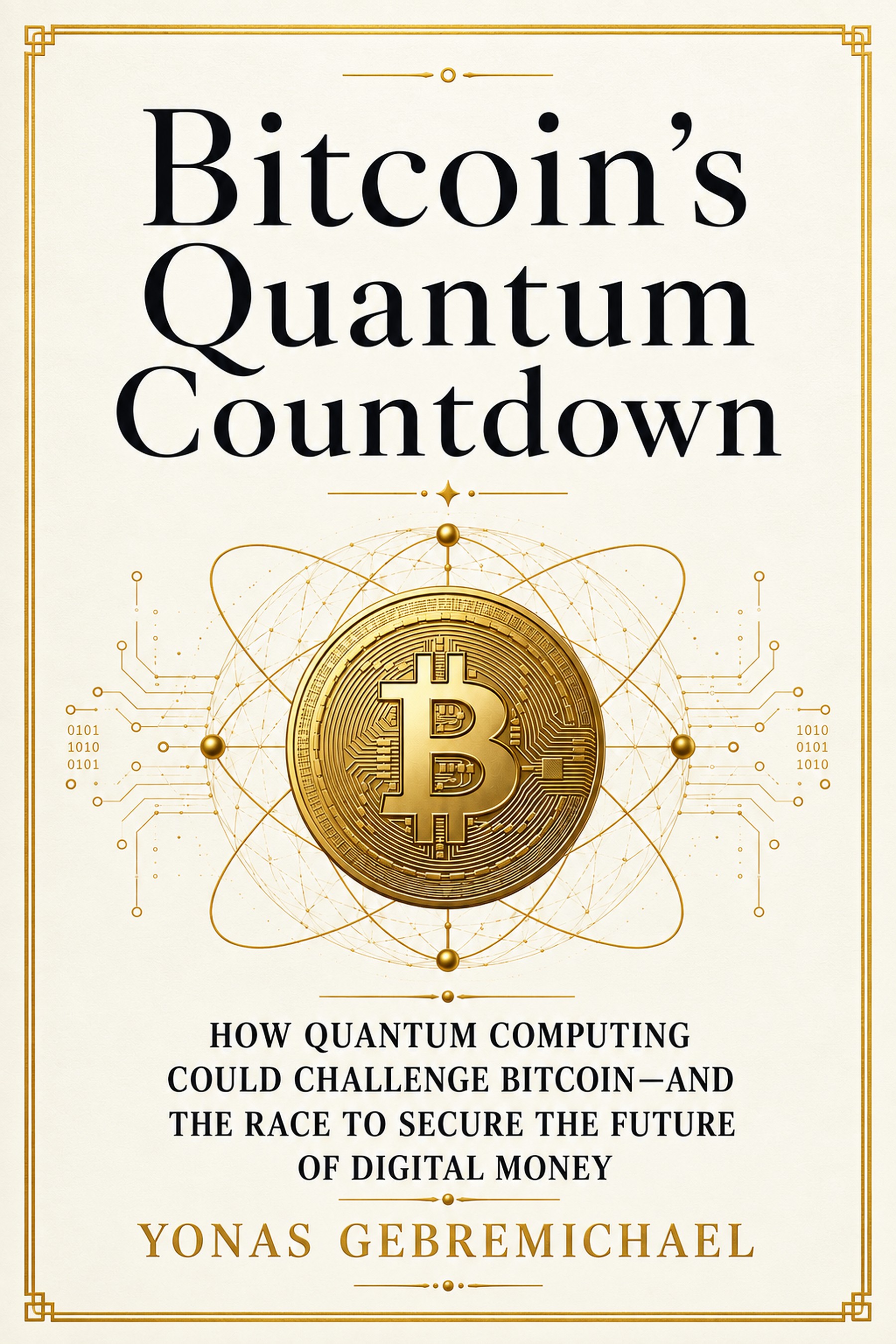
Book cover of Bitcoin's Quantum Countdown by Yonas Gebremichael, white and gold design with a Bitcoin coin inside an atomic orbital motif

The Central Question

What happens to Bitcoin's security model in a quantum future?

Bitcoin's ownership and signatures rest on cryptographic assumptions that have held for over a decade: specifically, that certain mathematical problems are impractically hard to solve with classical computers. Quantum computing research raises a long-term, technical question about whether some of those assumptions could someday weaken — not a certainty, not a prediction, and not a countdown to a known date.

Theoretical risk, not current capability

No quantum computer that exists today can break Bitcoin's cryptography. The relevant machines would need error rates, qubit counts, and stability far beyond anything publicly demonstrated. This book examines the trajectory of that research honestly — without claiming it has already arrived.

Uncertainty, not prediction

Nobody can responsibly name a fixed year when cryptographically relevant quantum computers will exist, if ever. Expert estimates vary widely and change as the underlying hardware research evolves. The book treats that uncertainty as the subject, not an inconvenience to explain away.

Preparation, not panic

Protocol-level cryptographic migrations take years of research, testing, and community coordination — regardless of when they become necessary. Understanding the options now is a matter of preparedness, not urgency.

What You'll Understand

A clear technical picture, built without hype

Bitcoin's Quantum Countdown is written for readers who want real substance — explained plainly, without inflating the threat or dismissing it.

Quantum computing fundamentals that actually matter for Bitcoin

A grounded introduction to qubits, quantum algorithms, and error correction — scoped tightly to what is relevant to cryptography, not a general physics survey.

The cryptographic assumptions Bitcoin relies on

How elliptic-curve signatures and hashing underpin Bitcoin's security, and precisely which mathematical assumptions quantum algorithms would need to undermine.

Theoretical versus practical risk

Why 'quantum computers could theoretically do X' and 'quantum computers can do X today' are very different claims — and how to tell which one you're reading elsewhere.

Defensive paths and migration options

The technical directions available for hardening Bitcoin against long-term quantum risk, and the real trade-offs each one involves.

Governance and coordination challenges

Why a decentralized, consensus-driven network faces a fundamentally harder upgrade problem than a centralized system — and what that means in practice.

Why preparation matters before an emergency

The case for treating this as a preparedness question now, while there is time for careful engineering, rather than a crisis to react to later.

Inside the Book

The major themes this book explores

A high-level view of what the book covers, presented as themes rather than a table of contents.

  1. 01

    The cryptography Bitcoin runs on

    How public-key signatures and hashing work together to secure ownership, and why that design has held up for over a decade of adversarial testing.

  2. 02

    What quantum computers threaten — and what they don’t

    A careful separation of Shor-type algorithms, which target the math behind digital signatures, from Grover-type search, which affects mining and hashing very differently.

  3. 03

    Paths toward quantum-resistant Bitcoin

    The technical directions researchers are exploring for post-quantum signatures, and the engineering trade-offs each path carries for a live, adversarial network.

  4. 04

    Coordination at scale

    Why upgrading a decentralized protocol used by millions is a fundamentally different challenge than patching a centralized system — and what history suggests about how Bitcoin upgrades happen.

  5. 05

    Preparing without panicking

    A grounded look at what meaningful preparation looks like for individuals, institutions, and the protocol itself — on a realistic timeline, not a manufactured one.

Available for preorder

Reserve your copy before October 20, 2026

Preorder on Amazon(opens Amazon in a new tab)

Who This Book Is For

Written for readers who take both Bitcoin and rigor seriously

Bitcoin readers

who want to understand a long-term risk to the network without wading through forum speculation.

Technical professionals

in software and systems who want the cryptography explained precisely and honestly.

Cybersecurity readers

tracking post-quantum cryptography and what it means outside the enterprise context.

Researchers

looking for a clear, well-scoped synthesis of the Bitcoin-and-quantum-computing literature.

Policymakers

who need the technical picture in plain language before questions of regulation or standards come up.

Journalists

covering Bitcoin, cryptography, or quantum computing who want a source that resists sensationalism.

Investors seeking technical understanding

who want the real technical picture, not speculation dressed up as analysis.

Curious general readers

who have heard the phrase "quantum threat to Bitcoin" and want an accessible, trustworthy explanation.

About the Author

Yonas Gebremichael

Yonas Gebremichael is the author of Bitcoin's Quantum Countdown, a nonfiction book examining the intersection of Bitcoin's cryptography and the trajectory of quantum computing research. The book approaches the subject with a technically grounded, non-alarmist voice — distinguishing established science from speculation, and theoretical risk from current capability.

A full author biography will be published here as it becomes available.

Frequently Asked Questions

Straight answers, no hype

Can current quantum computers break Bitcoin?

No. No quantum computer that exists today has anywhere near the scale, stability, or error correction needed to break the cryptography Bitcoin relies on. The book is explicit about this distinction between present-day capability and long-term theoretical risk.

Does the book predict a fixed collapse date for Bitcoin?

No. The book does not claim a specific 'Q-Day' or a year by which Bitcoin will be broken. Expert estimates on cryptographically relevant quantum computing vary widely, and the book treats that uncertainty honestly rather than manufacturing a deadline.

Is this book technical, or accessible to a general reader?

Both. It is written to be approachable for curious general readers while remaining precise enough for technical professionals, researchers, and cybersecurity readers who want real substance rather than a simplified summary.

Where can I preorder the book?

Bitcoin's Quantum Countdown is available for preorder now on Amazon, with a publication date of October 20, 2026.

Does this book give financial or investment advice?

No. The book is a technical and educational exploration of cryptography and quantum computing as they relate to Bitcoin. It does not offer financial, investment, or trading advice, and nothing on this website should be read as such.

What is the difference between Shor-type and Grover-type quantum risk?

Shor-type algorithms target the mathematical problems behind public-key signatures — the kind of risk relevant to Bitcoin's elliptic-curve cryptography. Grover-type search offers a much smaller, well-understood speedup against hashing and mining. The book explains why conflating the two leads to misleading claims, without asserting either has become a practical concern today.